zkMe zkPassport

Overview

Identity document verification requires more than document images and biometric matching. Traditional identity verification systems rely on visual artifacts and behavioral signals that lack any cryptographic link to the issuing authority. As generative AI makes these artifacts trivial to fabricate, image-based verification no longer provides a reliable foundation for authentic identity claims.

zkPassport addresses this structural limitation by shifting the trust anchor from visual evidence to cryptographic issuance. Every modern electronic passport contains a chip signed by the issuing country’s national PKI. zkPassport verifies this signature chain directly on the user’s device and generates a Zero Knowledge Proof that attests to the authenticity of sovereign-issued identity, without exposing personal data.

Identity authenticity is established by cryptography, not by appearance.


The Trust Anchor Problem

Digital identity verification has operated for decades on a fragile premise: that images of documents and biometric selfies are difficult enough to forge that they can serve as proof of identity. This premise is now broken.

Generative AI has rendered visual evidence structurally untrustworthy. Synthetic faces, fabricated document images, and real time deepfake video can deceive both human reviewers and automated systems. The problem is not that fraud detection models need better training; the problem is architectural. When the source document and the biometric reference can both be synthesized, the verification system is comparing one forgeable artifact against another. There is no ground truth.

The core issue is the absence of a trust anchor, a foundational element that cryptographically guarantees authenticity. Traditional eKYC systems infer document validity from visual security features. They infer liveness from behavioral signals in video. They infer authenticity from the absence of detected anomalies. But inference is not proof. These systems cannot answer the fundamental question: "How do I know this document was actually issued by the authority it claims?"

This is not a problem that can be solved by tuning risk parameters or improving anomaly detection. No amount of model refinement can introduce a trust anchor where none exists. The solution requires a different architecture entirely.


The Necessity of a Trust Anchor

Sovereign-issued identity is not a biographical fact like a name or date of birth. It is a legal status conferred by a sovereign nation. Proving a sovereign-issued identity claim requires demonstrating that a specific government authority has formally issued and signed that claim.

This creates two distinct challenges that traditional eKYC cannot address:

  • The Verification Gap: When a user uploads a passport image, the verifier has no cryptographic way to confirm that the document was genuinely issued by the claimed country. They can only confirm that the image appears to contain expected visual features. In an era of pixel perfect document forgery, this distinction is critical. Traditional eKYC can tell you what a document claims; it cannot tell you whether that claim is true.

  • The Privacy Paradox: Under conventional models, proving a sovereign-issued identity attribute requires exposing the entire identity document: full name, passport number, date of birth, place of birth, and facial photograph. Users must over disclose sensitive personal information to prove a single binary attribute. This creates a direct conflict between compliance requirements and data minimization principles, a conflict that document centric verification cannot resolve because it conflates data disclosure with proof.


The ePassport as a Cryptographic Trust Anchor

The electronic passport (ePassport), standardized under ICAO Document 9303, provides the trust anchor that traditional eKYC lacks. Its security architecture consists of multiple layers designed to prevent unauthorized access, data tampering, and chip cloning.

Security Mechanisms at the ePassport Layer

The following security mechanisms are part of the standard ePassport architecture. zkPassport builds on these foundations and focuses on Passive Authentication to establish cryptographic proof of issuance.

Mechanism
Purpose

BAC / PACE

Access control that prevents the chip from being read without authorization. The reader must first obtain keys derived from the Machine Readable Zone (MRZ) printed on the passport.

Passive Authentication (PA)

Data integrity verification through digital signatures. Ensures chip data has not been tampered with since issuance.

Active Authentication (AA)

Chip authenticity verification that prevents cloning. Proves the chip itself is genuine, not a copy.

zkPassport primarily leverages Passive Authentication, which provides the cryptographic proof that the data on the chip was signed by the issuing country.

Data Structure on the Chip

Passport data is organized into standardized Data Groups (DGs), each containing specific categories of information:

Data Group
Contents
Required

DG1

MRZ information (name, nationality, date of birth, passport number)

Mandatory

DG2

Facial image

Mandatory

DG3

Fingerprints

Optional

DG7

Signature image

Optional

DG11

Additional personal details

Optional

DG14

Security options for Active Authentication

Conditional

DG15

Active Authentication public key

Conditional

The Signature Chain

The integrity of these Data Groups is protected by a chain of cryptographic signatures:

Component
Full Name
Role

CSCA

Country Signing Certification Authority

Root certificate authority operated by each issuing country. The ultimate source of trust.

DS

Document Signer

Intermediate certificate signed by the CSCA. Used to sign individual passport data.

SOD

Security Object Document

A file stored on the chip containing hashes (digital fingerprints) of all Data Groups, signed by the DS.

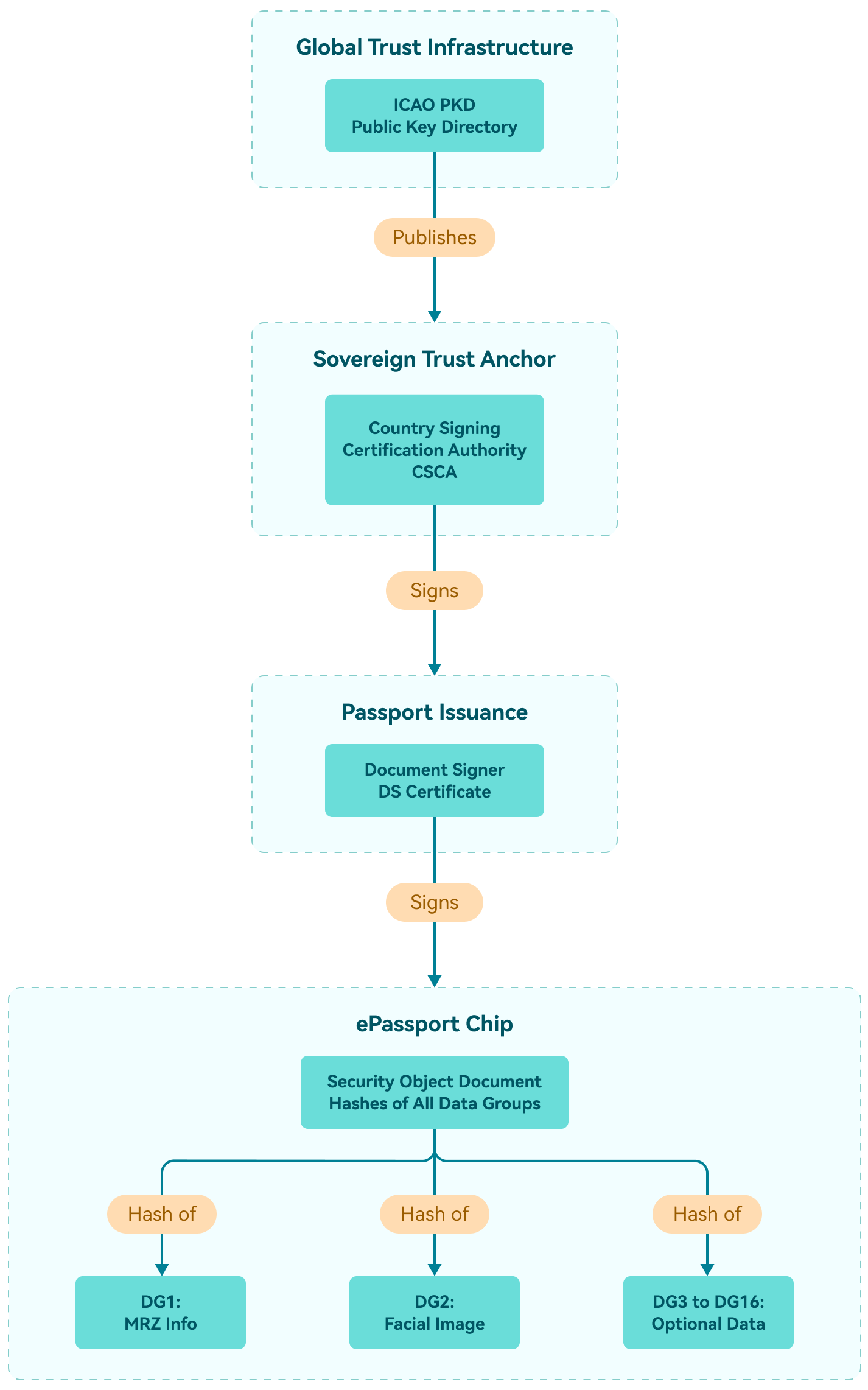
When a passport is issued, the hash of each Data Group is computed and stored in the SOD. The SOD is then signed using the Document Signer’s private key. The DS certificate, which contains the corresponding public key, is itself signed by the country’s CSCA.

Passive Authentication and Verification

This architecture enables Passive Authentication: any party with access to CSCA public keys can verify, without any network connectivity or interaction with the issuing government, that:

  1. The data on the passport chip has not been modified since issuance (by comparing DG hashes against the SOD).

  2. The SOD was signed by a valid Document Signer certificate.

  3. The DS certificate chains to the country’s CSCA.

  4. The passport was therefore issued by the claimed sovereign authority.

The verification is deterministic, not probabilistic. The signature either validates or it does not. There is no confidence score, no threshold tuning, no model drift.

The ICAO Public Key Directory (PKD)

CSCA certificates are exchanged between countries through the ICAO Public Key Directory (PKD) and bilateral diplomatic channels. The PKD is a globally shared certificate repository maintained by the International Civil Aviation Organization, currently containing over 800 CSCA certificates and 20,000 Document Signer certificates from participating countries.

This creates a global web of trust rooted in sovereign authority, precisely the foundation required for reliable verification of sovereign-issued identity claims. If a country has not submitted its certificates to the PKD, other countries cannot cryptographically verify passports issued by that country.


The zkPassport Trust Model

zkPassport leverages the ePassport trust anchor while solving the privacy paradox through Zero Knowledge Proofs.

The conventional approach to using ePassport data would be to read the chip, verify the signatures, and transmit the verified data to a relying party. This is cryptographically sound but still requires full data disclosure. zkPassport introduces a different model: verification without disclosure.

Dual-Layer Proof Architecture

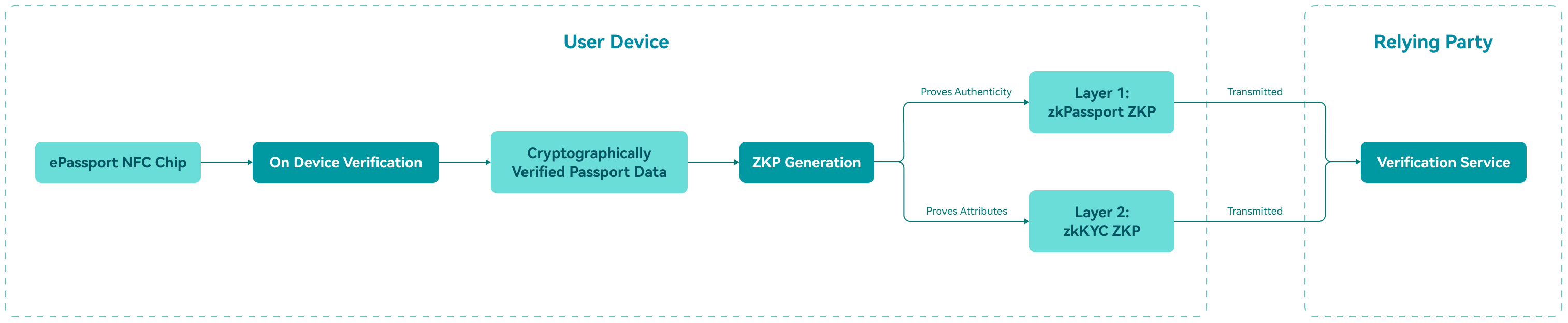
zkPassport generates two distinct types of proof:

Layer
Proof Type
What It Proves

Layer 1

zkPassport ZKP (Authenticity Proof)

The user possesses a cryptographically valid ePassport issued by a specific country

Layer 2

zkKYC ZKP (Attribute Proof)

A specific attribute (nationality, age threshold) is true, based on the verified passport data

The first layer establishes that the passport is genuine. The second layer proves specific claims derived from that passport. Neither layer reveals the underlying data.

On-Device Processing

All sensitive operations occur on the user’s device:

Operation
Location
Data Exposure

NFC chip reading

User device

None

Signature verification

User device

None

ZKP generation

User device

None

Proof verification

Relying party

Proof only

Raw passport data never leaves the device. The relying party receives only the Zero Knowledge Proof, which cannot be reverse engineered into the original data. Privacy is guaranteed by cryptography, not by policy.


Resulting Capabilities

zkPassport resolves the structural problems that make traditional eKYC unsuitable for Proof of Citizenship.

  • Cryptographic Proof of Sovereign Issuance: Verification of sovereign-issued identity claims is no longer based on visual inspection of documents. It is based on cryptographic signatures issued by sovereign governments. When a zkPassport proof attests to a sovereign-issued identity claim, that attestation is mathematically bound to the issuing authority’s CSCA. The relying party trusts mathematics, not artifacts.

  • Privacy Preserving Compliance: Users prove specific sovereign-issued identity attributes without disclosing name, passport number, date of birth, or any other personal data. Services can verify nationality for compliance purposes without accumulating sensitive data that creates liability and attracts attackers.

  • Immunity to Synthetic Identity Attacks: The trust anchor is a cryptographic signature embedded in a physical chip. An attacker cannot generate a valid CSCA signature; only the issuing government possesses the private key. Deepfakes and synthetic documents are irrelevant to a verification model that does not rely on visual evidence.

  • Reusable and Revocable Credentials: Proofs can be anchored to a user’s wallet as Soul Bound Tokens or Verifiable Credentials, enabling reuse across services. Because proofs are bound to specific certificates, they inherit the revocation properties of the underlying PKI.

  • Auditability Without Surveillance: Relying parties can demonstrate that citizenship verification occurred without maintaining databases of passport data. Compliance is provable; surveillance is unnecessary.

  • Global Coverage: zkPassport supports electronic passports from 126 countries and regions that have published their signing certificates to recognized registries. This represents the vast majority of ePassports in global circulation. For the complete list of supported countries, see Supported Countries.


Trust Model and Security Assumptions

zkPassport’s security guarantees depend on a set of foundational assumptions about the underlying infrastructure.

zkPassport Dependencies

Assumption
Description

Government PKI Integrity

CSCA certificates published by governments are authentic and have not been compromised

ICAO Standard Compliance

The passport chip implements ICAO Doc 9303 standards correctly

Physical Chip Security

The passport chip has not been physically cloned or its private keys extracted

Device Security

The user’s mobile device has not been compromised in a way that would allow interception of NFC communication

zkPassport Verification Scope

Verification
Description

Certificate Chain Validation

The Document Signer certificate is validated against the known CSCA certificate for the issuing country

Data Integrity Check

The hash of each Data Group is compared against the signed Security Object Document (SOD)

MRZ to NFC Consistency

The data read from the NFC chip is compared against the MRZ data to ensure they refer to the same document

Identity verification is not a data collection problem. It is a trust problem, and trust must be cryptographic.

Identity authenticity must be rooted in cryptographic trust, not visual evidence.

Last updated