> For the complete documentation index, see [llms.txt](https://docs.zk.me/hub/llms.txt). Markdown versions of documentation pages are available by appending `.md` to page URLs; this page is available as [Markdown](https://docs.zk.me/hub/why/vision.md).
# Vision & Philosophy
## Vision & Mission
### + Vision
> ***A world where financial autonomy is not limited by security, knowledge, nor system boundaries. In the trustless world of tomorrow, Humans confidently entrust management of their financials to AI, and Agents transact with absolute, cryptographic trust.***
### + Mission
> ***We build the leading infra for securing, verifying & bridging Identity for the Agent Economy. We empower AI Agents to handle firewalled secrets, instantly underwrite owners & counterparties, and effectively navigate an ever increasing complex economy.***
## Design Philosophy
### Core Concept
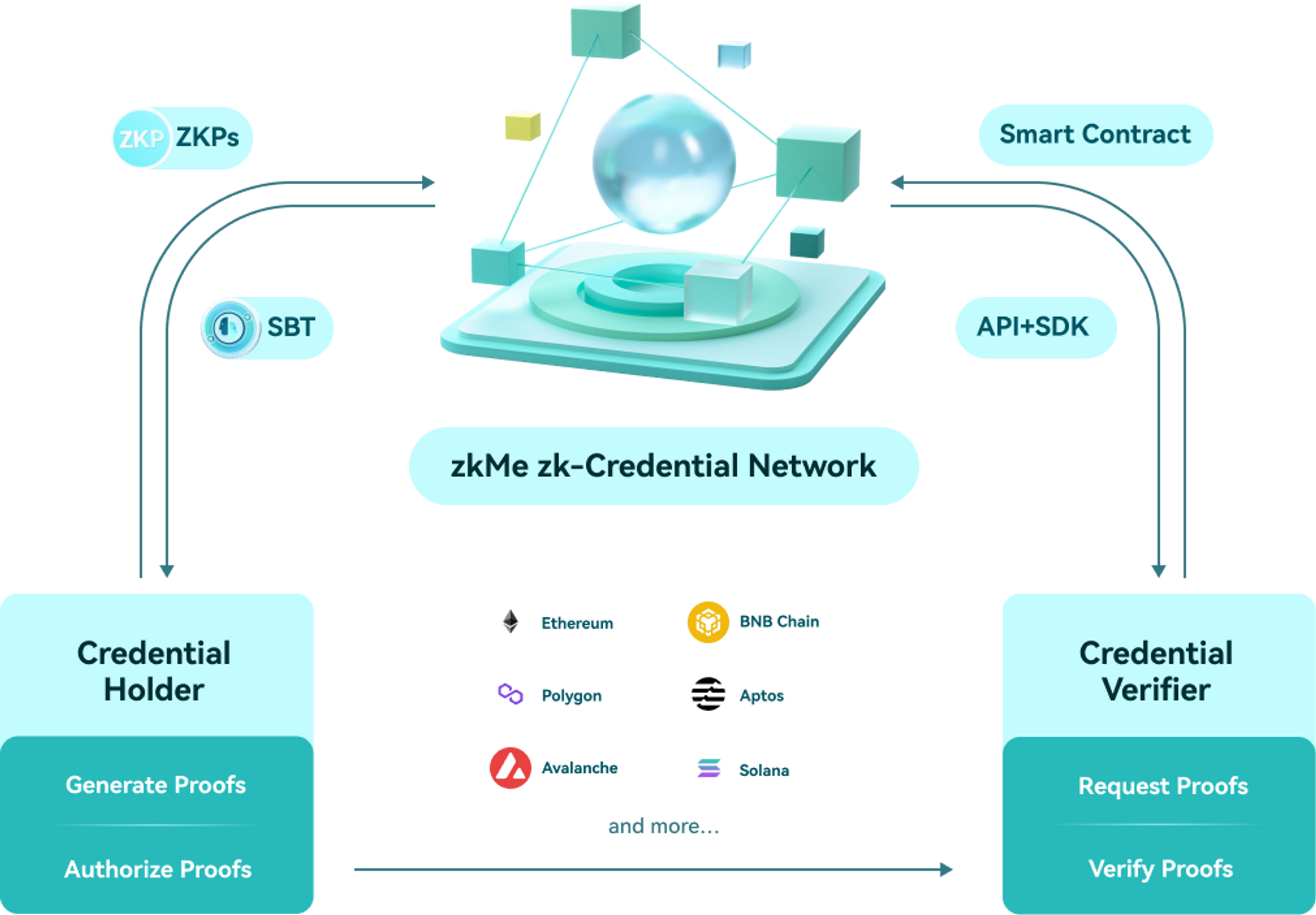
zkMe provides a comprehensive privacy-preserving credential solution emphasizing zero-knowledge processing and selective disclosure. It implements Self-Sovereign Identities while maintaining regulatory compliance across finance, commerce, healthcare, government services, and the Agent Economy.
The platform prioritizes three foundational principles:
**Privacy-by-Design.** Personal data processes automatically on end devices or decentralized oracles, ensuring no unauthorized access and user control over information sharing with project-level permission revocation capabilities.
**Decentralization.** Trust determinations operate through decentralized node operator protocols, eliminating single-entity control while remaining party-agnostic across infrastructure roles.
**Transparency.** Open-source algorithms undergo regular audits, enabling credential cross-pollination across web3, web2, and real-life identity ecosystems.
These principles extend naturally to AI agents through the [**Secure**](/hub/how-built/id-infra.md)**,** [**Underwrite**](/hub/how-built/credential-sys.md)**,** and [**Gate**](/hub/how-built/agent-trust-gateway.md) pillars: agents receive self-sovereign identity credentials stored in an encrypted zkVault, their credentials compose with human credentials to form end-to-end trust chains, and agent operations comply with regulatory frameworks through cryptographically-enforced scope limits and principal accountability.
zkMe expands upon W3C Verifiable Credentials standards through:
* Replacing centralized issuers with open-source, trustless zero-knowledge verification algorithms
* Using Multi-Party Computation Oracles to bridge credentials across ecosystems
* Storing zero-knowledge proof verified presentations as Soulbound Tokens on-chain
* Decentralizing credential registries via anonymous proofs on distributed storage
* Extending identity infrastructure to AI agents through [zkKYA](/hub/what/zkkya.md) credentials, including Agent Principal, Agent Certification, Agent Intent, Agent Reputation, and Agent Payment Facilitation
***
### Leading Design Considerations
#### **Compliance**
zkMe incorporates regulatory compliance with FATF's 2019 crypto KYC/AML recommendations, EU 6AML and TRF directives, emerging EU MiCA, US CLARITY Act, Stablecoin Compliance Requirements (SCR), the Agent Responsibility and Verification Act (ARVA), while adhering to W3C DIDs, VC, and VP standards. The system supports Crypto Travel Rule compliance and agent principal accountability, ensuring that the human or legal entity behind every agent action is always identifiable to regulators.
#### **Interoperability**
The system ensures credentials verified once function across any blockchain and any agent framework through a chain-agnostic and role-agnostic architecture independent of zkMe Technology Limited. Agent interoperability is achieved via MCP Server integration and the [Agent Trust Gateway](/hub/how-built/agent-trust-gateway.md), which translates credentials from any trusted issuer into a standardized format consumable by any service provider.
#### **User Experience**
Design priorities include:
* Conversion Rate optimization
* Self-Sovereignty maintenance
* Agent-native interfaces for programmatic credential management
#### **End-to-End Zero-Knowledge**
The protocol guarantees:
* No unilateral Personally Identifiable Information access
* No data sharing between parties
* No indirect identification mechanisms
* Verifiable end-to-end cryptographic integrity
* Agent secrets encrypted at rest with AES-256-GCM and accessible only within TEE enclaves
***
### High Level Process Flow
#### **Credential ****Creation**
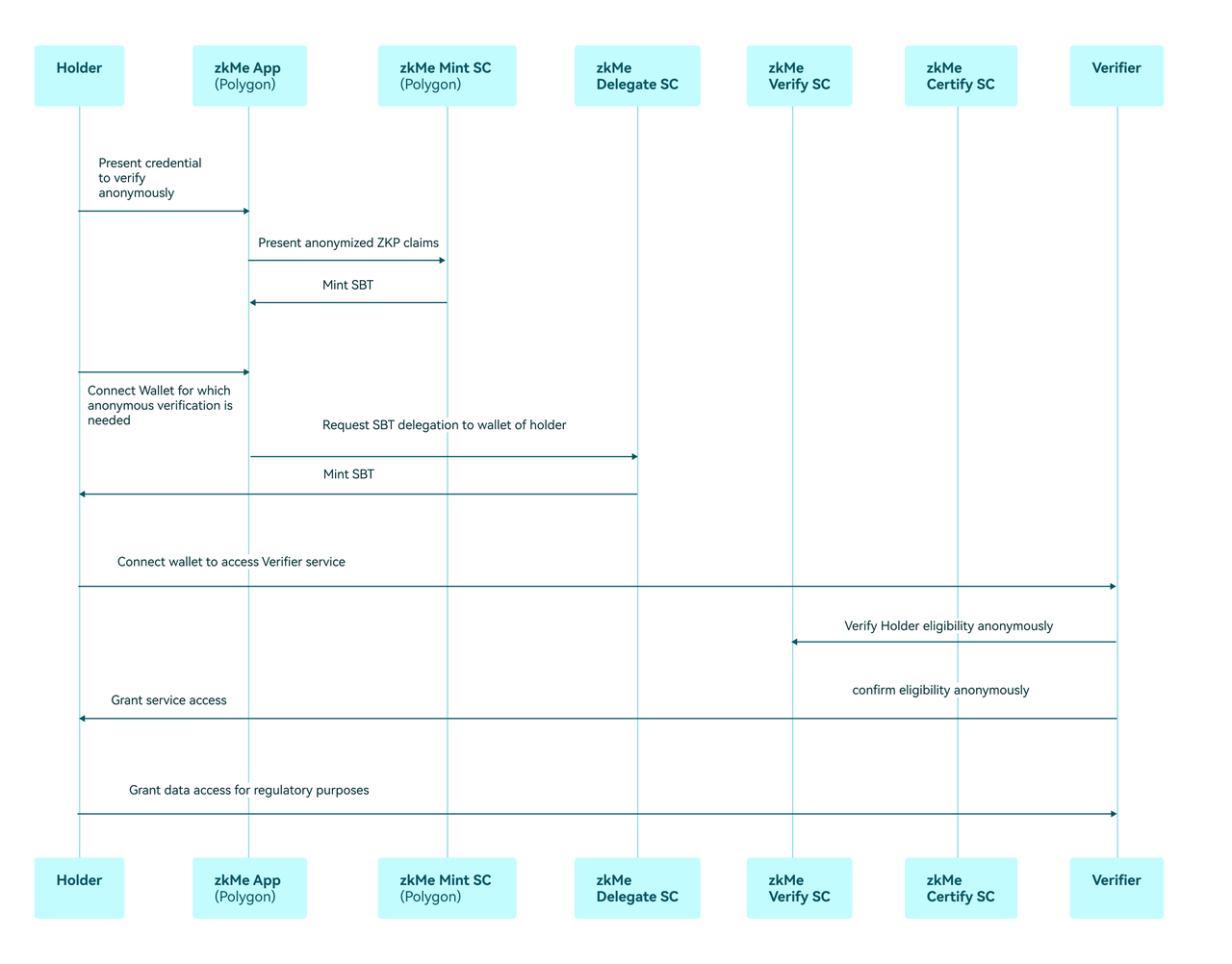
Holders present off-chain credentials to open-source verification algorithms running locally on mobile devices. The algorithm generates anonymized, tamper-proof Zero-Knowledge Proofs, sent to MPC node Oracles for consistency verification. Upon validation, a smart contract mints a credential proof Soulbound Token to the Holder's Self-Sovereign Identity Wallet.
For AI agents, the equivalent step is **Agent Registration**: agent developers register agents with a unique identifier, including model metadata and deployment context. The agent's identity is cryptographically bound to its principal's human or entity identity via an Agent Principal credential.
#### **Credential ****Presentation**
When proving eligibility, Holders generate new ZKPs from their credential proof SBTs locally on their devices. They specify precise claims based on Verifier requirements. A ZKP circuit generates cryptographic proofs attesting to claim truthfulness without revealing additional personal information, embodying selective disclosure principles.
For agents, credential presentation is programmatic: when an agent requests access to a service or initiates a transaction, it generates a Zero-Knowledge Proof from its relevant credentials ([APC](/hub/what/zkkya/apc.md), [ACC](/hub/what/zkkya/acc.md), [AIC](/hub/what/zkkya/aic.md), [ARC](/hub/what/zkkya/arc.md), or [APF](/hub/what/zkkya/apf.md)) and submits it to the verifier via the Agent Trust Gateway. The agent proves specific claims, such as meeting a minimum reputation threshold or holding valid certification, without revealing the underlying data.
#### **Credential ****Verification**
Holders submit generated ZKPs to Verifiers, who invoke smart contracts or APIs passing proofs as inputs. The cryptographic verification checks ZKP integrity and correctness, confirming only true/false claim validation while revealing nothing else about Holder identity, ensuring privacy-by-design protections.
For agents, verification occurs via the **8-step Session Secret Sharing flow**: the agent calls the Agent Trust Gateway, which checks scope and policy; the risk engine grades the action; the user approves on their phone via the SSI Wallet; the TEE signs a PASETO action token; the TEE decrypts credentials in the enclave; an isolated container executes on the target service; the result is returned and audit-logged to an immutable record.
#### **Credential ****Attestation**
Holders delegate credential proofs to chosen blockchain ecosystems via signed delegation transactions from SSI-Wallets. A Delegate Smart Contract bridges the SBT onto the selected chain.
Holders access Verifier services by connecting wallets. Verifiers invoke either Verify smart contracts for one-time yes/no verification, or [**Certify**](/hub/how-built/id-infra/smart-contracts.md#zkme-verify-and-certify) smart contracts for maintaining auditable verification records enabling regulator action against bad actors. Certification requires additional Holder signature approval.
{% hint style="info" %}
***Note:** Steps 3.1.1–3.1.3 can be bypassed when Holders reuse previously verified credentials. The same reusability applies to agents: once registered and credentialed, agents present existing credentials without re-registration.*
{% endhint %}
---
# Agent Instructions
This documentation is published with GitBook. GitBook is the documentation platform designed so that both humans and AI agents can read, navigate, and reason over technical content effectively. Learn more at gitbook.com.
## Querying This Documentation
If you need additional information that is not directly available in this page, you can query the documentation by asking a question.
Perform an HTTP GET request on the following URL with the `ask` and `goal` query parameters:
```
GET https://docs.zk.me/hub/why/vision.md?ask=&goal=
```
`ask` is the immediate question: it should be specific, self-contained, and written in natural language.
`goal` is what the user is ultimately trying to achieve, the reason they need the answer. Sharing it helps GitBook give you a better, more relevant answer. A goal is most helpful when it describes the outcome the user wants rather than restating the question. For example, with `ask=how do I create an API token`, a goal like `automate deployments from our CI pipeline` lets GitBook tailor the answer to that use case.
The response will contain a direct answer to the question and relevant excerpts and sources from the documentation.
Use this mechanism when the answer is not explicitly present in the current page, you need clarification or additional context, or you want to retrieve related documentation sections.