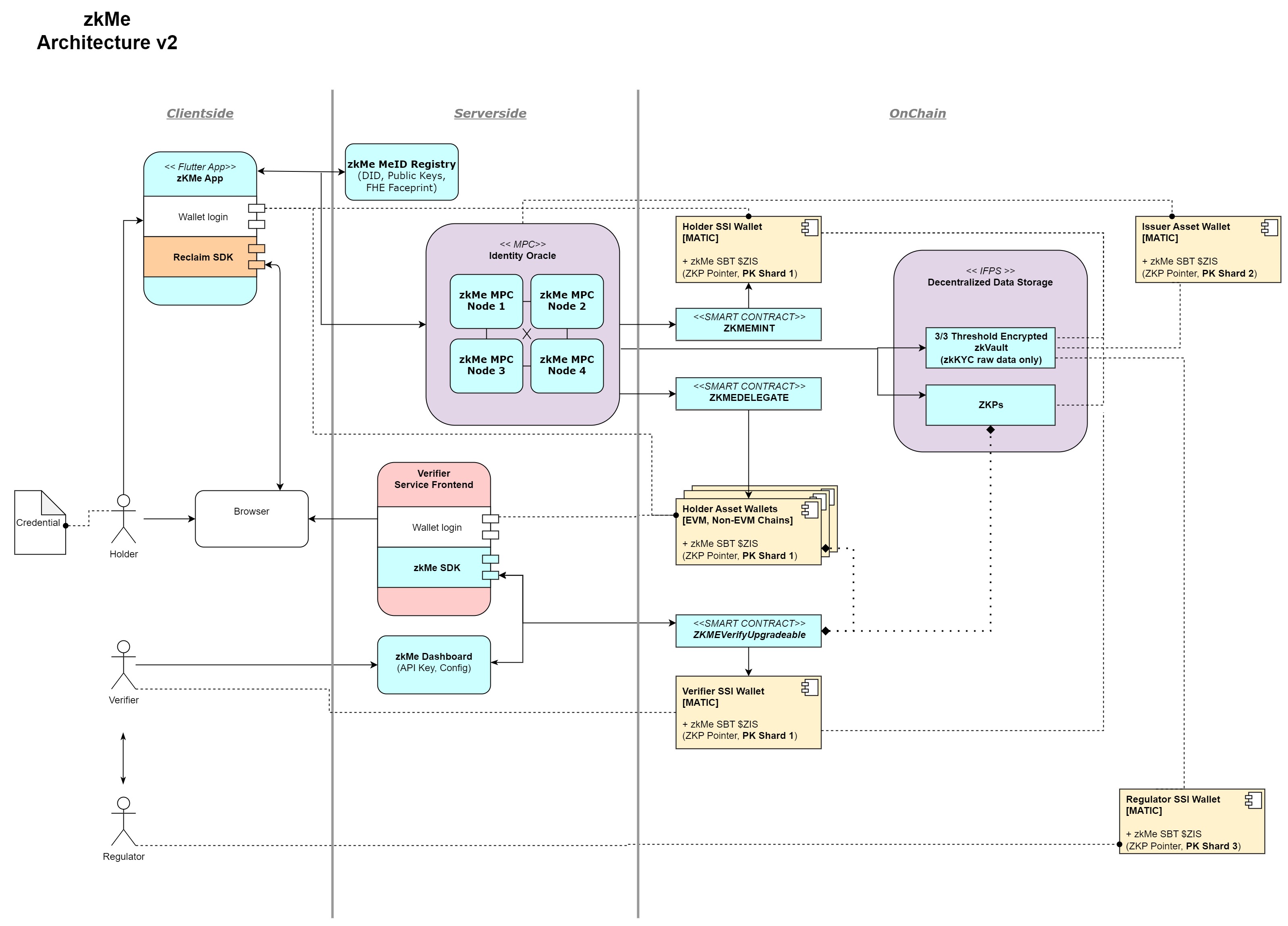
zkMe Architecture v2
zkMe Architecture v2
| Module | Description |
|---|---|
| zkMe Identity Chain | Purpose-built Layer 1 EVM-compatible blockchain (CometBFT PoS + EVMOS) serving as the settlement and persistence foundation for all identity operations. Provides instant finality, sub-second block times, and a Decentralized Storage Provider network optimized for credential payloads. |
| zkMe Self-Sovereign Identity | The SSI model underpinning zkMe, including the evolved role definitions (Credential Issuer, ZKP Issuer, Holder, Verifier, Regulator), the zkMe SBT, and the zkMe App (MPC-based SSI wallet). |
| zkMe DID Method | The did:zkme specification, on-chain DID Registry smart contract, CRUD operations, and DID Document resolution. |
| zkMe zkVault | Encrypted secrets management combining TEE-based key hierarchy with threshold encryption (EC-ElGamal), decentralized credential storage on IPFS, and the data recovery procedure for regulatory compliance. |
| zkMe FHE | Fully Homomorphic Encryption using the CKKS scheme, enabling computation on encrypted facial feature vectors for privacy-preserving DID creation (Face-to-DID). |
| zkMe zkPassport | Privacy-preserving ePassport verification using NFC chip reading, Active Authentication, and zero-knowledge proof generation from ICAO 9303 data. |
| zkMe zkTLS | Zero-Knowledge Transport Layer Security for trustless extraction and attestation of Web2 data (bank accounts, credit scores, government records) without exposing raw session content. |
| zkMe Smart Contracts | On-chain contract suite including zkMe Mint, Delegate, Verify & Certify contracts, with deployment addresses across all supported chains. |
| Module | Description |
|---|---|
| Core Concepts | System overview, design goals, the Issuer-Holder-Verifier trust triangle, system architecture (4-layer model), credential data model (W3C VC), Claim Tree and commitment model, full credential lifecycle (issuance, verification, revocation, expiration), and cryptographic assumptions. |
| Selective Disclosure | Fine-grained privacy control allowing Holders to reveal only specific credential fields via the SD operator. Supports 14 query operators for range matching, set membership, and field extraction. Gas-optimized on-chain verification via circuitQueryHash compression. |
| Multi-Credential Proofs & Delegation | Batch verification of up to 10 queries across multiple credentials in a single proof (LinkedMultiQuery10). Cross-chain identity portability via Delegated Proofs bound to secondary addresses or AI agent DIDs. |
| Anti-Sybil Mechanisms | Nullifier-based uniqueness enforcement for "one person, one action" guarantees. Unified authentication supporting both BabyJubJub keys and standard Ethereum wallet signatures. Unified SIG/MTP circuit. |
| Reusable Credentials | The "Verify Once, Prove Anywhere" paradigm, cross-chain credential portability via Delegate smart contracts, and lifecycle management for reusable credentials. |
| Agent-Ready Credentials | Credentials optimized for AI agent consumption, featuring cryptographic delegation, machine-readable schemas, and automated proof generation. |
| Module | Description |
|---|---|
| Agent Trust Gateway Stack | Core positioning, architectural components (TEE Enclave, Policy Engine, Credential Verifier, Protocol Adapters), and the high-level trust flow. |
| Agent Session Flow | The complete 8-step session lifecycle from initiation through TEE ingress, credential verification, policy evaluation, optional human-in-the-loop authorization, context provisioning, execution proxying, to audit logging. |
| Supported Protocols | Native protocol adapters including MCP, APF/x402, W3C VC/DID, ERC-8004, OIDC4VP, zkTLS, and PASETO. |
| Tool | Description |
|---|---|
| zkMe App | The MPC-based SSI wallet for mobile credential management, featuring OCR document scanning, facial recognition, ZKP generation, and SBT minting. |
| zkMe SDK | JavaScript SDK for embedding credential verification into web applications. |
| zkMe Dashboard | Management interface for Verifiers to configure verification profiles, define business eligibility rules, and access analytics. |
| zkMe API | RESTful API for programmatic access to KYC and KYT verification services. |
| Pillar | Commercially Available Technology |
|---|---|
| Identity Infrastructure | 8 modules available for independent licensing. See Identity Infrastructure: Available as Independent Services for the full catalog and acquisition models. |
| Credential System | 6 capabilities available for independent licensing. See Credential System: Available as Independent Services for the full catalog and acquisition models. |
| Agent Trust Gateway | 7 capabilities available for independent licensing. See Agent Trust Gateway: Available as Independent Services for the full catalog and acquisition models. |